
Search Richmond County Court Records
Richmond County court records are searched first through the statewide North Carolina eCourts Portal. The portal has Smart Search for case information, Search Hearings for court dates, Make Payments for eligible citations and cases, and NC Judgment Search for judgment index data. Richmond County is not served by a separate county-run court case website. The local route is the state portal, then the public terminal or paper file at the Richmond County Clerk of Superior Court when the online view is limited.
The Judicial Branch Richmond County page is the best official starting point for local court links. It points users toward calendars, payment information, local rules, court date search, and courthouse contacts. Portal searches may require JavaScript, cookies, supported browsers, and CAPTCHA checks. If a record is old, sealed, not digitized, or blocked in the public view, the clerk's office remains the record source.
- Open the eCourts Portal and choose Smart Search for case records or Search Hearings for dates.
- Use the record number or a party name in last-name, first-name format.
- Open Advanced Filtering Options when a common name returns too many matches.
- Set Richmond County as the location when the tool allows a county filter.
- Review the case summary, events, hearings, dispositions, and financial fields that are public.
- Contact the Clerk of Superior Court for certified copies, paper files, or terminal searches.
The official Portal training page explains that case summaries can include case information, assignment information, party information, causes of action, case events, dispositions, hearings, and financial information. Those fields help with lookup, but they are not always the same as a certified court record.
The manifest image from the Richmond County Judicial Branch landing page shows the official local court entry point.
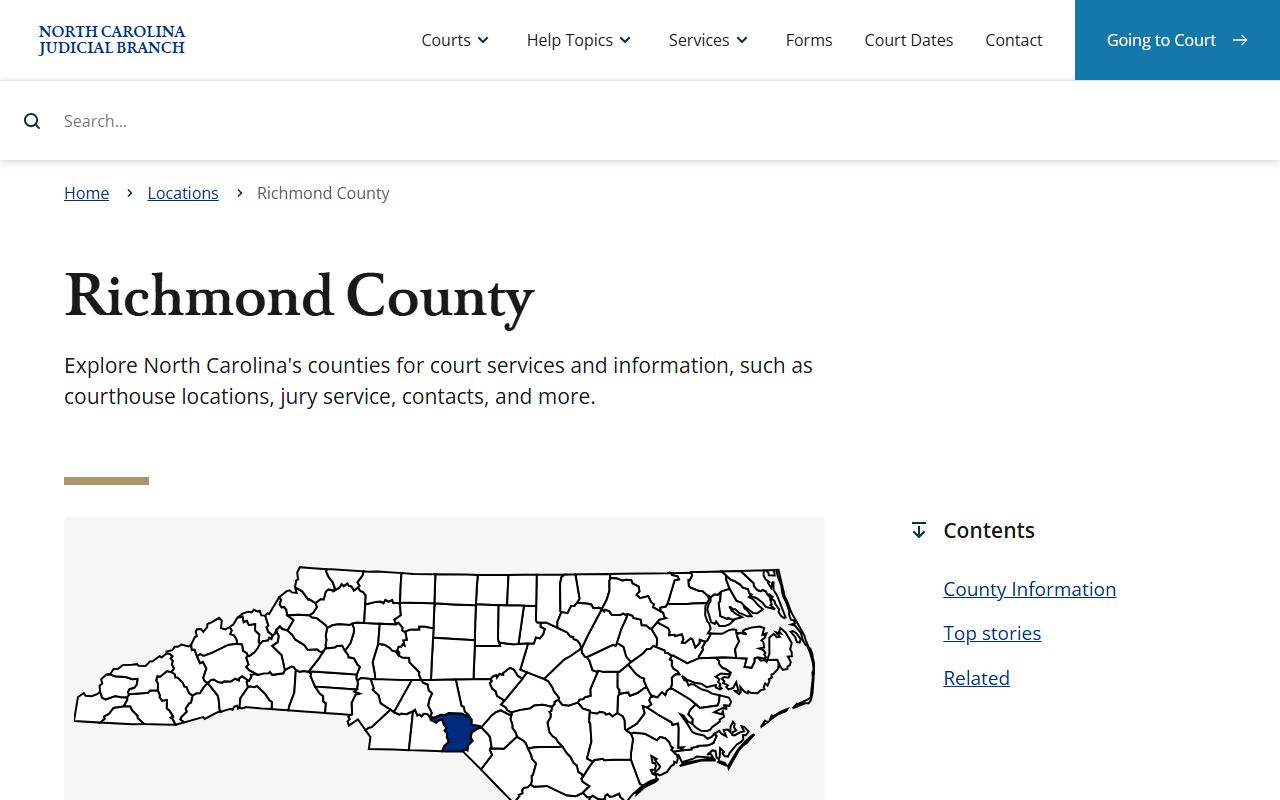
That local page is useful because it joins county court links with statewide search services instead of sending users to a separate Richmond-only court database.
Richmond County Court System
North Carolina has a unified General Court of Justice. Richmond County has no separate city or county-created court system for ordinary criminal, traffic, civil, or family cases. Local cases move through the Superior Court Division, District Court Division, magistrates, and the Clerk of Superior Court. Appeals can move to the North Carolina Court of Appeals and, in some matters, the Supreme Court of North Carolina.
Richmond County is in Prosecutorial District 21, Superior Court District 21, and District Court District 21. Superior Court handles felony cases, civil cases involving $25,000 or more, and appeals from District Court. District Court handles misdemeanors, infractions, civil cases between $10,000 and $25,000, domestic matters, juvenile matters, small claims through magistrate proceedings, and most traffic cases.
Case flow: Magistrate or District Court › Superior Court when jurisdiction or appeal requires it › North Carolina Court of Appeals › Supreme Court of North Carolina when review is available.
| Court or Office | Richmond County Role | Common Case Types |
|---|---|---|
| Superior Court Division | Trial court for higher-level matters | Felonies, large civil cases, District Court appeals |
| District Court Division | Primary court for many local filings | Misdemeanors, traffic, domestic, juvenile, small claims |
| Magistrates | Judicial officers for initial process | Initial appearances, criminal process, small claims, summary ejectments |
| Clerk of Superior Court | Record keeper and probate judge | Court files, estates, copies, certified background checks |
Richmond County Court Offices
The main courthouse is the Richmond County Judicial Center in Rockingham. The Judicial Branch lists the visit and mailing address as 105 W Franklin St, Rockingham, NC 28379, with main phone (910) 419-7400 and weekday hours of 8:00 AM to 5:00 PM. The court ecosystem also includes the sheriff, jail, and Register of Deeds on or near Franklin Street and Court Street.
The Richmond County Judicial Center page provides the courthouse address and service details.
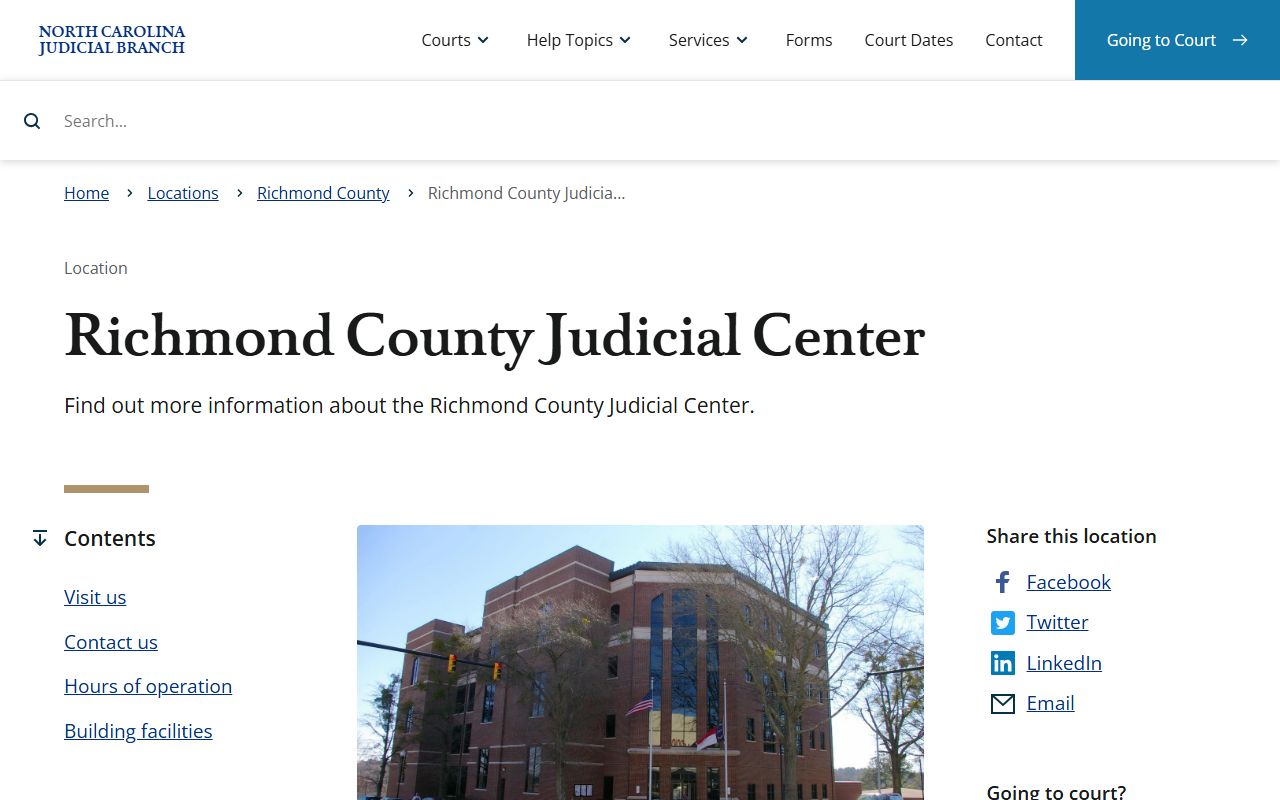
The Judicial Center is the place to confirm hearing arrival rules, courthouse hours, and clerk access before a visit.
Richmond County Judicial Center
105 W Franklin St
Rockingham, NC 28379
(910) 419-7400
Judicial Branch courthouse page
Richmond County Sheriff
114 E. Franklin Street, Suite 105
Rockingham, NC 28379
(910) 895-3232
Richmond County Sheriff
Register of Deeds
114 E. Franklin Street, Room 101
Rockingham, NC 28379
(910) 997-8250
Richmond County Register of Deeds
Richmond County Court Record Types
Richmond County court records include civil, criminal, family, probate, traffic, small claims, and judgment records. Civil files can include complaints, answers, motions, orders, judgments, liens, lis pendens, partitions, and foreclosure-related proceedings. Criminal files can include charges, court dates, pleas, dispositions, sentencing, fines, costs, and probation obligations. Family files include divorce, custody, child support, domestic violence, and juvenile matters, though some family and juvenile records are restricted.
Marriage and land records are not court records in Richmond County. They are handled by the Register of Deeds. Divorce judgments are court records held by the Clerk of Superior Court, while divorce certificates are available through North Carolina Vital Records. Jail booking data is also separate from the court case file, even when the jail profile shows a court date or charge.
- Civil records include lawsuits, judgments, special proceedings, liens, and related filings.
- Criminal court records include case events, pleas, dispositions, and sentences after charges are filed.
- Family records include divorce, custody, child support, and domestic violence filings with access limits.
- Probate records include wills, estate administration, guardianships, and related special proceedings.
- Traffic records include citations, waiver or appearance status, costs, and DMV reporting.
Richmond County Court Record Fields
Portal records and clerk files do not all show the same level of detail. A public online case summary may show case events, parties, hearings, dispositions, and financial data. A paper file at the clerk's office may include pleadings, orders, notices, exhibits, and other documents that are not visible online. Family Court uses local file numbers such as 00-CVD-0123, and Portal payment examples show criminal case formats such as 15CR123456-910.
| Field | What It Shows |
|---|---|
| Case Number | The court file identifier, often with year and case-type letters. |
| Parties | Names and roles such as plaintiff, defendant, petitioner, or respondent. |
| Case Events | The register of actions, including filings, hearings, orders, and dispositions. |
| Hearings | Scheduled court dates, hearing type, location, and related case information when public. |
| Disposition | The outcome of a claim, charge, motion, judgment, or case. |
| Financial Information | Costs, fines, fees, or judgment data when the public case view includes it. |
Richmond County Court Access Laws
North Carolina court records are governed by court-record rules as well as broader public-record statutes. G.S. 7A-109 says clerks maintain records, dockets, files, and indexes and that nonrestricted court records are open for public inspection during regular office hours. Chapter 132 applies to state and local public records, including many sheriff and county administrative records, but court files still route through the court access system.
Judicial Branch public-record requests are used for existing Judicial Branch administrative records. They do not replace the clerk's role for court files, paper case records, certified copies, and public terminal access. Public access also has limits. Juvenile, adoption, mental health, sealed, expunged, and personally identifying information may be closed or redacted.
Key statutes:
G.S. 7A-109 controls clerk record keeping and public inspection of nonrestricted court records.
G.S. Chapter 132 covers many North Carolina public records outside the court case file itself.
G.S. 15A-145.5 addresses expunction of certain nonviolent misdemeanor and felony records.
Richmond County Portal Fields
Smart Search is the broad case lookup tool. Searchers can use a record number, party name, or advanced filters. The tool has wildcard rules, business-name instructions, location filters, case-type filters, status filters, date fields, and party fields. Search Hearings has its own required fields for location, hearing types, and search types.
The statewide eCourts Portal home shows tiles for Smart Search, hearings, payments, and judgment search.
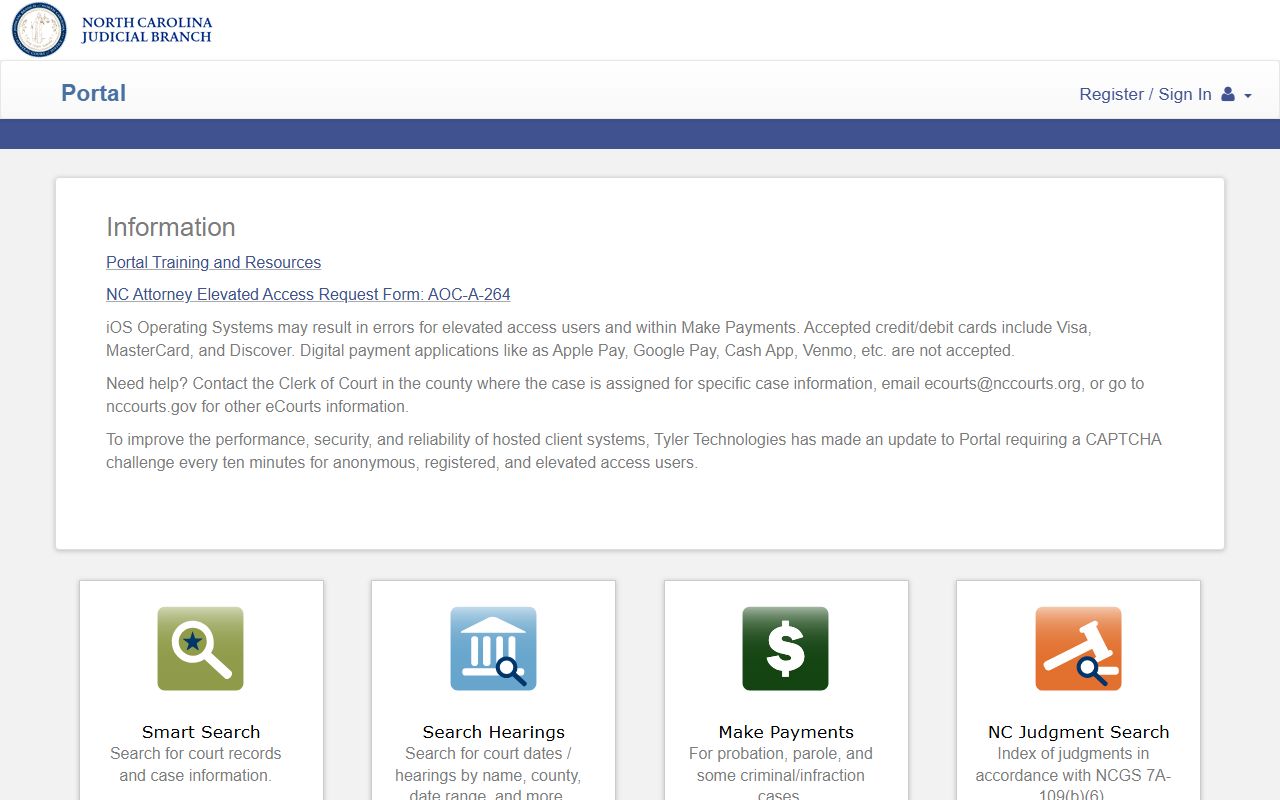
The Portal home matters because Richmond County case lookup depends on those statewide tools rather than a county-made court search page.
| Field Label | Type | Required | Notes |
|---|---|---|---|
| Record Number or Name | text | yes for basic search | Uses case number or last, first middle suffix format. |
| Filter by Location | dropdown | optional | Select Richmond County for county-specific results. |
| Search by | radio/dropdown | optional | Party Name, Nickname, Business Name, or Sounds Like. |
| File Date Start / End | date | optional | Narrows by filing date range. |
| Select Hearing Types | dropdown/multi-select | required in Search Hearings | Includes civil, criminal, family, probate, and mental health. |
Restricted Richmond County Records
Not every Richmond County court record is open online or open at the counter. Juvenile delinquency, many abuse and neglect matters, adoption files, sealed cases, expunged criminal records, and mental health commitment details may be closed from ordinary public view. Expunction can remove or seal state records of qualifying arrests, charges, or convictions, but it does not always erase every collateral effect or every private database copy.
Personal identifiers are also protected. Richmond County Register of Deeds online records cite G.S. 132-1.8(g), which allows written redaction requests for Social Security numbers, taxpayer ID numbers, driver license numbers, state ID numbers, passport numbers, bank and card numbers, PINs, and passwords in online register images. That rule is separate from court-record access, but it shows how public records can still have privacy limits.
Note: If a record is sealed, expunged, juvenile, or adoption-related, do not assume it is available through Portal or a clerk terminal.
Richmond County Jail Records
The Richmond County Sheriff is Mark B. Gulledge. The Sheriff website links to inmate information, the jail, sex-offender search, and court-date tools. The jail is at 1 Court St., Rockingham, NC 28379. The jail phone is (910) 997-8265, and the Sheriff main phone is (910) 895-3232. The online jail application can search by name, charge description, or recent booking days.
The official Sheriff inmate information page links to the Richmond County Jail lookup and warns users about charge and bond information.
The jail lookup is useful for custody status, charge descriptions, bond fields, court dates, and arresting agency data, but it is not the same as the full criminal court file.
Richmond County Warrant Records
No official Richmond County Sheriff public active-warrant search was found in the research. A warrant check therefore runs through a fallback chain: the Sheriff's Office for law-enforcement questions, Magistrates for criminal process questions, the Clerk of Superior Court for returned process and case-file records, Portal for related criminal cases and hearing dates, and the jail roster if the warrant has led to custody.
Bench warrants or orders for arrest after missed court may appear in case events or custody records after service or return, but an active unserved warrant may not appear in an online public case search. For risk of arrest, felony, DWI, domestic violence, probation, or fugitive matters, a lawyer is the safer contact before appearing in person.
Marriage Divorce and Probate Records
Marriage records and marriage licenses are handled by the Richmond County Register of Deeds, not the Clerk of Superior Court. The Register of Deeds lists marriage records from 1779 to current, births and deaths from 1913 to current, delayed births, certified vital copies, and noncertified copies. The Register's online system includes a Consolidated Index, Old Index Books, a Vital Index, image viewing, and help tabs.
Divorce judgments are court records held by the Clerk of Superior Court in the county where the divorce was granted. Divorce certificates are available through North Carolina Vital Records. Probate and estates are handled by the Clerk of Superior Court acting as ex officio judge of probate. Filed wills become public records after death, while some guardianship, mental health, and minor-related estate matters can have access limits.
- Probate
- The court process that validates a will and starts estate administration.
- Personal representative
- The person authorized by the clerk to manage estate assets and debts.
- Will caveat
- A challenge to a will's validity that is heard by a Superior Court judge.
Richmond County Record Fees
Fees depend on the office and record type. The research found a $25 certified single-county criminal background check through the Clerk of Superior Court using Form AOC-CR-314. Richmond County court payments by mail must be made by money order or certified check payable to Richmond County Clerk of Superior Court. In-person court payments may use cash, credit or debit card with a processing fee, money order, or certified check. Personal checks are not accepted for those court payment channels.
| Item | Amount or Rule |
|---|---|
| Certified single-county criminal background check | $25 through Clerk of Superior Court |
| Certified vital copy at Register of Deeds | $10 each |
| Non-certified Register of Deeds copy | $0.35 each |
| Online court card payment | Processing fee applies; MasterCard, Visa, Discover accepted |
| Mail court payment | Money order or certified check only |
Richmond County Traffic Records
Traffic citations in Richmond County are District Court matters unless the offense moves into a more serious criminal track. The Judicial Branch traffic help topic explains that waiving an offense by paying in full is treated as being guilty or responsible as charged. That can affect a driver license and insurance. Some offenses are waivable. Others require a court appearance or, in some cases, an attorney appearance.
The eCourts Make Payments tool can search by citation number, case number, party name, business name, or driver's license information. Richmond County payment instructions allow mail payment by money order or certified check, in-person payment at the courthouse cashier, and eligible online payments by card. Driver records and crash reports are separate DMV records, not clerk case files.
The manifest image from eCourts Make Payments shows the payment search route used for eligible Richmond County citations.
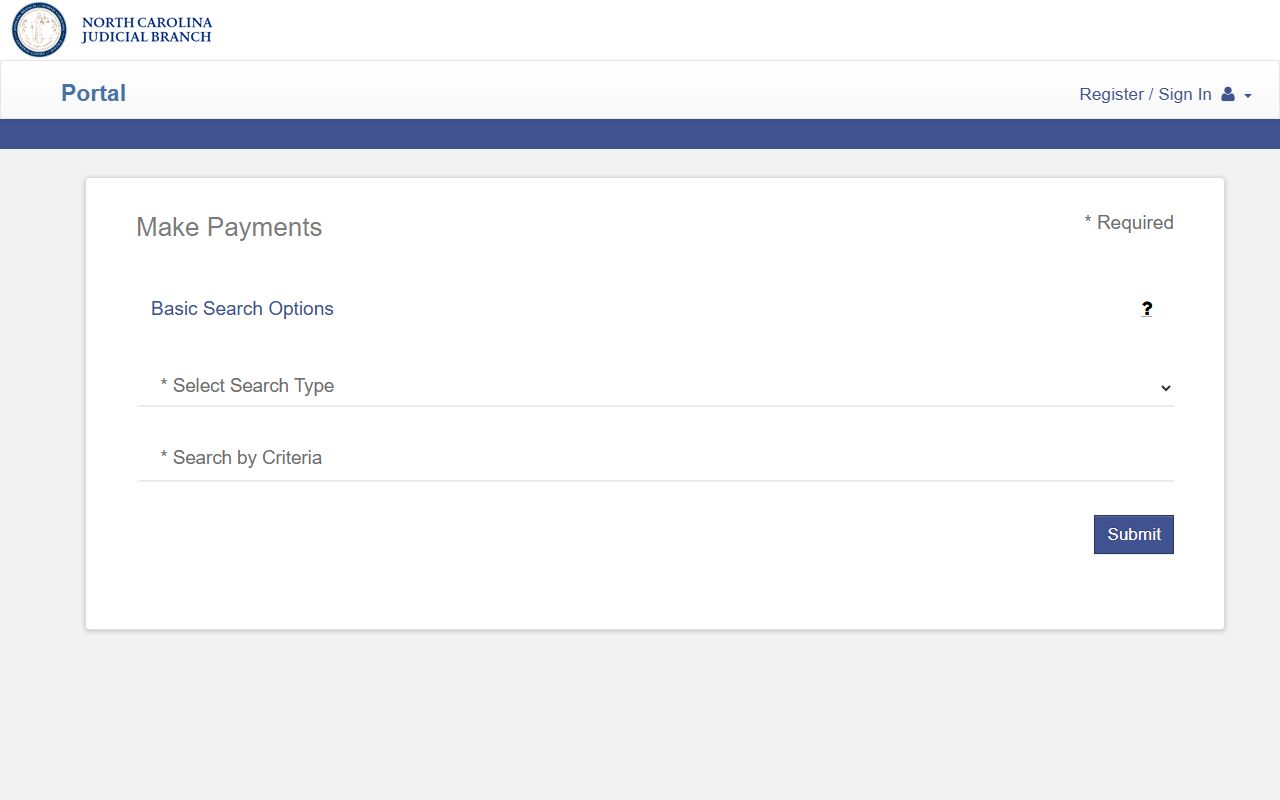
That tool helps with eligible payments, but contested tickets and must-appear offenses still run through court.
Richmond County Local Rules
Local rules and forms can affect scheduling, continuances, pretrial release, domestic practice, and remote hearings. The Richmond County local rules and forms page lists District 21 administrative orders and local materials. Family Court Administration has separate contact details and tells callers to have the file number ready, using a local example format of 00-CVD-0123.
The portal training page is shown in the manifest image from the Judicial Branch portal training source.
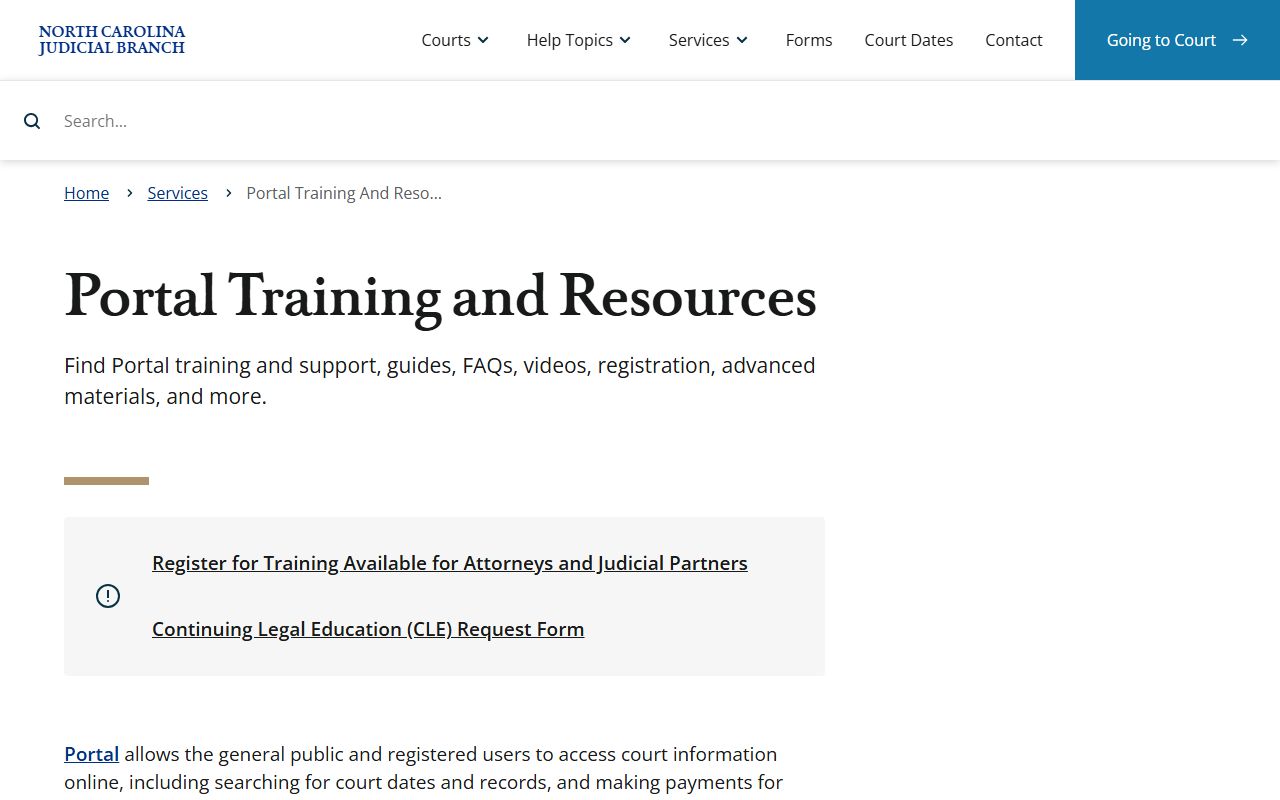
Portal training and local rules are different resources, but both help users understand how records and hearings appear in the statewide system.
Richmond County Court History
Richmond County was formed in 1779 from Anson County, and Rockingham is the county seat. Historic courthouse materials identify Richmond County's courthouse tradition as part of North Carolina courthouse architecture. Secondary summaries of National Register material describe the older courthouse as built in 1922 to 1923, designed by Charlotte architect Charles C. Hook, and listed on the National Register of Historic Places in 1979.
Current court access has changed with eCourts. Richmond County now uses statewide Portal tools for case search, hearing search, payments, and judgment search, while older records and paper files may still require clerk contact. Recent local changes also include Jamie Adams becoming District Attorney for Prosecutorial District 21 in 2024.
Richmond County Court FAQs
Where are Richmond County court records searched?
Use the North Carolina eCourts Portal for online case information and court dates. Use the Richmond County Clerk of Superior Court for certified copies, paper files, public terminal access, divorce judgments, probate files, and certified single-county criminal background checks.
Does Richmond County have a public warrant search?
No official public active-warrant search was found. Use the Sheriff, Magistrates, Clerk, Portal, and jail roster depending on whether the question is about active process, a court case, custody, or a returned order.
Are marriage records court records?
No. Richmond County marriage records are Register of Deeds records. Divorce judgments are court records at the Clerk of Superior Court, while divorce certificates are state vital records.
Can online court records be used as certified copies?
No. Online case details help with lookup, but certified copies must come from the Clerk of Superior Court or the office that issued the record.