
Richmond County Criminal Court Records
A Richmond County criminal court record is the court case file, not just the arrest entry. It begins when a criminal matter is filed or reaches court and then grows as hearings, pleadings, motions, pleas, orders, dispositions, and sentencing entries are added. The Clerk of Superior Court is the local record-keeping office for criminal court files, while the District Attorney prosecutes criminal cases for Prosecutorial District 21.
North Carolina's court structure matters when reading Richmond County criminal records. Misdemeanors and infractions usually begin in District Court. Felonies are prosecuted in Superior Court, and Superior Court also hears appeals from District Court. Magistrates handle initial appearances, criminal process, and related early-stage duties. City police or county deputies may make the arrest, but the court record belongs to the statewide General Court of Justice.
The Judicial Branch source on the District Attorney appointment is assigned to this Richmond County criminal court records page.
That source connects criminal court records to Prosecutorial District 21, which covers Anson, Richmond, and Scotland Counties.
Search Richmond County Criminal Court Records
The main online search path is eCourts Smart Search. Search by case number when possible, or by defendant name using the Portal's Last, First Middle Suffix format. Use Advanced Filtering Options to narrow by Richmond County, case type, case status, and filing date range. For court dates, use Search Hearings. If the Portal is blocked by browser settings, CAPTCHA, older paper records, or limited public fields, use a public terminal or contact the Clerk of Superior Court.
- Open Smart Search in the North Carolina eCourts Portal.
- Search by criminal case number, record number, or defendant name.
- Filter location to Richmond County and narrow by criminal case type or filing dates when needed.
- Open the case summary and review charges, events, hearings, disposition, and financial fields that are public.
- Request certified copies, paper file access, or a certified criminal background check from the Clerk of Superior Court.
The Judicial Branch criminal background check source is part of the Richmond County criminal court records source set.
That source is important because a Portal search is not the same as a certified Richmond County criminal background check.
Richmond County Criminal Case Flow
Criminal records are easier to read when the case flow is clear. A charge may appear before any conviction exists. Hearings and motions may change the path of the case. A disposition may resolve one charge while another remains pending. Sentencing may add confinement, probation, fines, costs, restitution, or other court-ordered terms.
Case flow: Charges Filed › Arraignment › Pretrial / Motions › Plea or Trial › Disposition › Sentencing
| Stage | What Happens |
|---|---|
| Charges Filed | The accusation enters the court record through a charging document, citation, warrant, information, or indictment. |
| Arraignment | The charge and plea process is addressed, and future court dates may be set. |
| Pretrial / Motions | Attorneys may file motions, request continuances, negotiate pleas, or address evidence and release issues. |
| Plea or Trial | The case may resolve by plea, bench trial, jury trial, dismissal, or other court action. |
| Disposition | The record shows the outcome for a charge or case, such as guilty, not guilty, dismissed, or another result. |
| Sentencing | The court records punishment, probation, costs, fines, restitution, or other terms if a conviction or responsible finding occurs. |
What Richmond County Criminal Records Show
Richmond County criminal court records may include the case number, defendant name, charges, case status, court location, hearings, events, attorney information where public, disposition, financial information, and sentencing details. The Portal training source describes case summaries and register-of-actions fields, while the paper file may contain filings and orders not fully displayed online.
| Field | What It Shows |
|---|---|
| Case Number | The criminal file identifier, with research examples showing CR in North Carolina criminal case numbers. |
| Defendant | The person charged in the Richmond County criminal case. |
| Charges | The offenses filed with the court, which may differ from initial jail booking language. |
| Hearings | Scheduled or completed court appearances, including criminal settings shown through Search Hearings. |
| Plea | The defendant's response to a charge when the plea is part of the public record. |
| Disposition | The outcome for each charge or case, such as conviction, dismissal, or not guilty result. |
| Sentence | Confinement, probation, costs, fines, restitution, or other court orders when applicable. |
Richmond County Charges vs Convictions
A charge is an accusation. A conviction is an outcome based on a plea or finding of guilt. Richmond County criminal court records can show charges that were amended, reduced, dismissed, or resolved without conviction. This distinction matters when reading a docket, a jail charge screen, or a criminal case summary. For the arrest-to-charge path before final disposition, use the Richmond County arrest records and court charges page.
| Charge | Conviction | |
|---|---|---|
| Meaning | An accusation filed or carried into court. | A guilty plea, verdict, or responsible finding entered by the court. |
| Timing | Appears early in the case and may change. | Appears after plea, trial, waiver, or other final court action. |
| Record Risk | May remain visible unless dismissed and expunged or otherwise restricted. | May affect sentencing, probation, fines, costs, and background checks. |
| Best Source | Charge list, docket entries, jail detail, and prosecutor filings. | Disposition, judgment, sentence, and certified clerk records. |
Public Access to Richmond County Criminal Records
Public access to Richmond County criminal court records is based on G.S. 7A-109, which requires clerks to maintain court records, files, dockets, and indexes and opens them for public inspection unless the law bars access. Criminal court records may also intersect with Chapter 132 public-records rules when sheriff or agency records are requested outside the court file.
Key Statutes:
G.S. 7A-109 - clerks maintain court records and public inspection is allowed unless prohibited by law.
G.S. 15A-145.5 - certain nonviolent misdemeanor and felony records may qualify for expunction when statutory conditions are met.
The adult criminal expunction statute source is included in the Richmond County criminal court records image set.
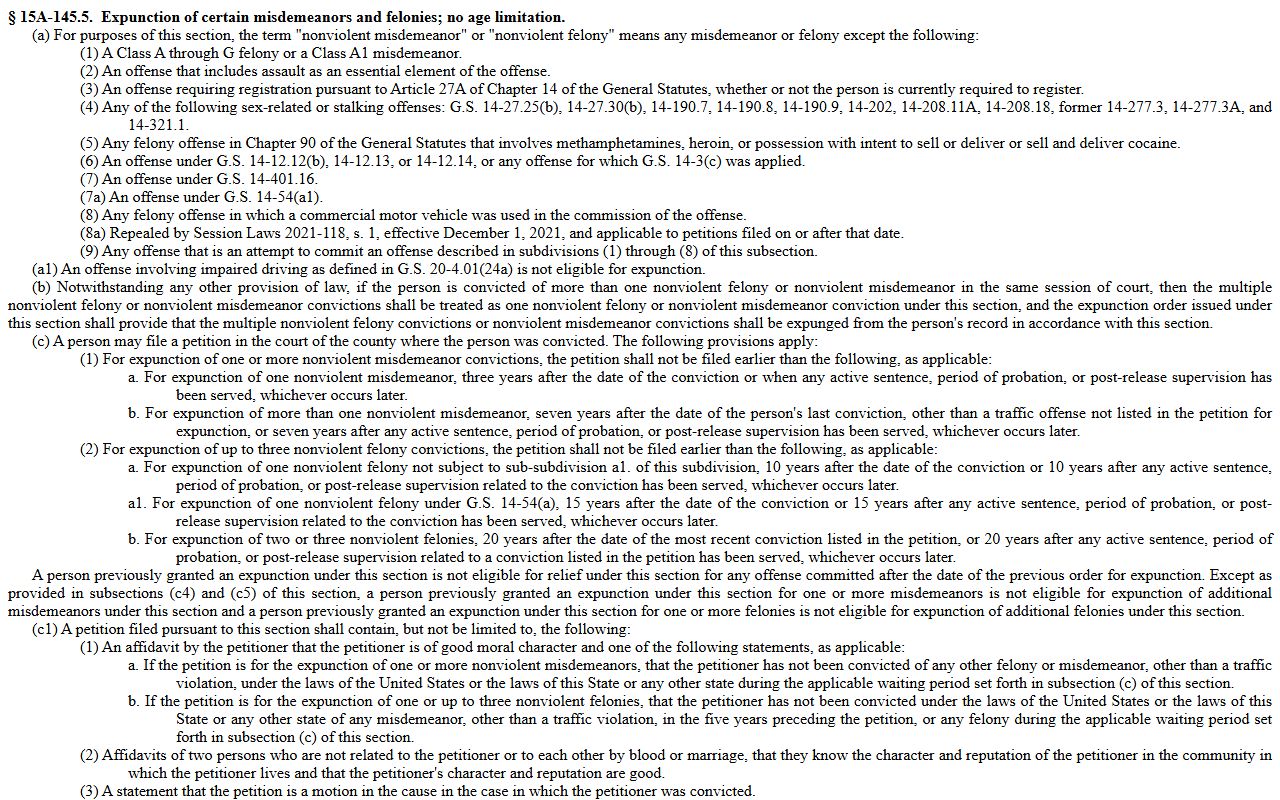
The statute supports a narrow point: expunction is eligibility-based and cannot be assumed from dismissal, age of the case, or lack of recent activity.
Sealed vs Expunged Criminal Records
Sealed and expunged are not the same. A sealed record is closed from ordinary public view by law or order. An expunged record is removed, sealed, or destroyed under a statutory process for qualifying charges or convictions. North Carolina's expunction rules are specific, and the Judicial Branch warns that expunction may not remove every consequence, including some federal immigration consequences.
| Sealed | Expunged | |
|---|---|---|
| Public View | Hidden from ordinary public access. | Removed or sealed after a qualifying order is processed. |
| How It Happens | By statute or court order based on case type or facts. | By petition, statutory review, and court order when eligible. |
| Examples | Juvenile, adoption, mental health, or other restricted matters. | Some nonviolent misdemeanors or felonies under state expunction law. |
| Local Starting Point | Clerk or court order tied to the case. | Richmond County case number, disposition, correct AOC form, and filing in the case county. |
Richmond County Background Checks
A certified single-county criminal background check is handled through the Clerk of Superior Court, not by relying on a casual Portal name search. The Judicial Branch source identifies Form AOC-CR-314 and the researched $25 fee for a certified name search in one county. The request can be submitted to the clerk by mail or in person, with payment rules that differ between mail and counter service.
State prison, probation, parole, sex-offender, and victim-notification searches are different from Richmond County criminal court records. The NC Department of Adult Correction offender search includes state offender data and expressly differs from county jail information. Jail custody and charge information may help locate a person, but it does not replace the court's criminal case file.
The North Carolina Indigent Defense Services Richmond County source is assigned to this criminal records page.
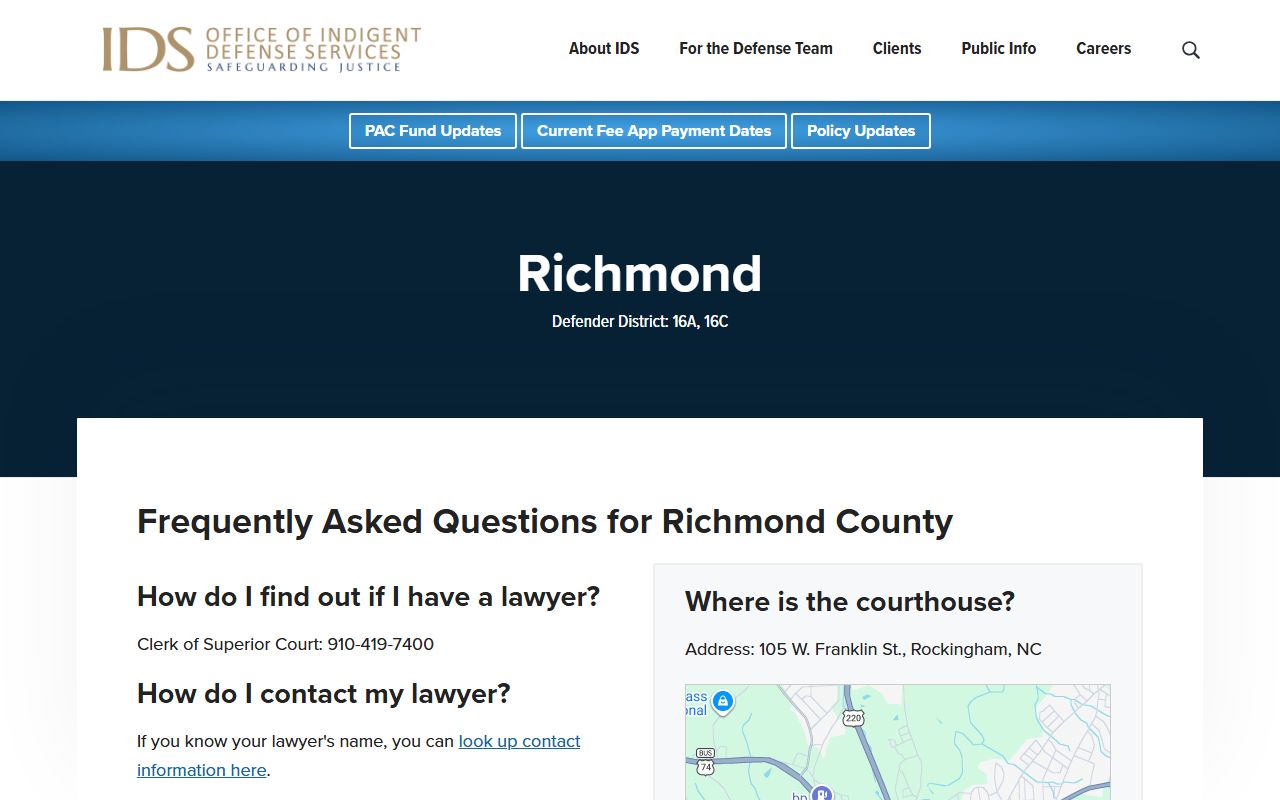
Defense-service information is relevant because the clerk can help users determine whether a lawyer is assigned when the case record is unclear.
Restricted Richmond County Criminal Records
Restricted criminal records include juvenile matters, sealed records, expunged records, and some records affected by privacy rules or court orders. A pending case can also have limits on what appears remotely. Mental health details, adoption records, and certain family or juvenile records are not ordinary criminal court records even when a related event appears in court activity.
The District Attorney for Prosecutorial District 21 prosecutes criminal cases in Richmond County and prepares the criminal trial docket. The Prosecutorial District 21 source is included in the Richmond County criminal court records source set.
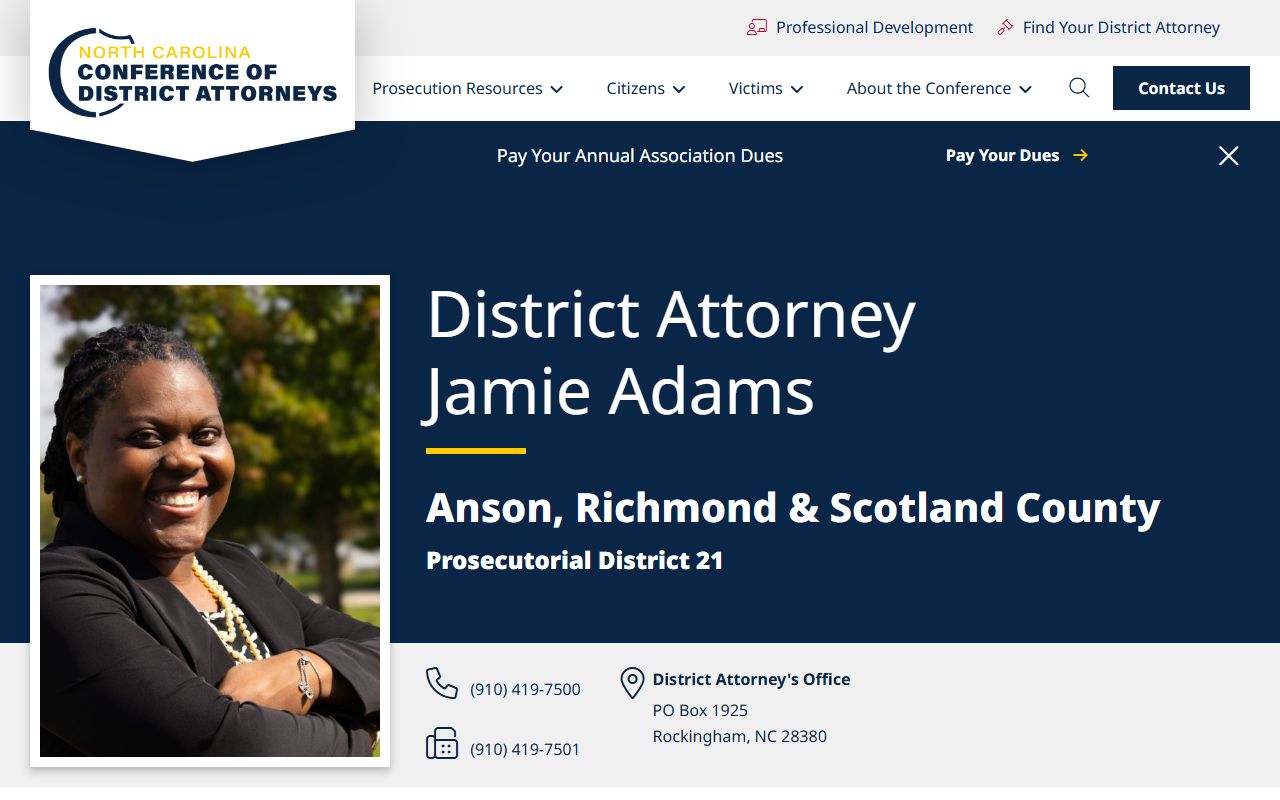
The DA source helps separate prosecution duties from clerk record access, defense questions, jail custody, and public case lookup.