
How to Search Richmond County Court Records
The main online path for Richmond County court records is the North Carolina eCourts Portal. Richmond County does not run a separate county case-search site for Superior Court or District Court files. The Portal groups Smart Search, Search Hearings, Make Payments, and NC Judgment Search in one statewide system. Smart Search is the broad case lookup tool. Search Hearings is the better tool for court dates. Judgment Search is narrower and is tied to the judgment index described in court-record law.
The Portal uses public search fields, browser checks, cookies, JavaScript, and a CAPTCHA notice that may interrupt longer sessions. Use the case number if it is known. If only a name is known, follow the Portal's name format and use Richmond County as the location filter. If the record does not appear, the next access channel is the public terminal in a clerk's office, followed by paper file inspection at the Richmond County Clerk of Superior Court.
- Open the eCourts Portal and choose Smart Search for case records or Search Hearings for court dates.
- Enter the case number, record number, or party name in the Last, First Middle Suffix format used by the Portal.
- Open Advanced Filtering Options and set the location to Richmond County when county-specific results are needed.
- Review the case summary, register of actions, events, hearings, dispositions, and financial fields shown to the public.
- For certified copies, paper filings, or records not shown online, contact the Clerk of Superior Court at the Richmond County Judicial Center.
The Judicial Branch describes court-record routes on its obtaining court records page. That source is useful when a Richmond County court record is not online because it explains terminals, paper files, divorce judgments, police reports, and records held by the Register of Deeds.
The North Carolina court-records help topic is shown in this Richmond County court records source image.
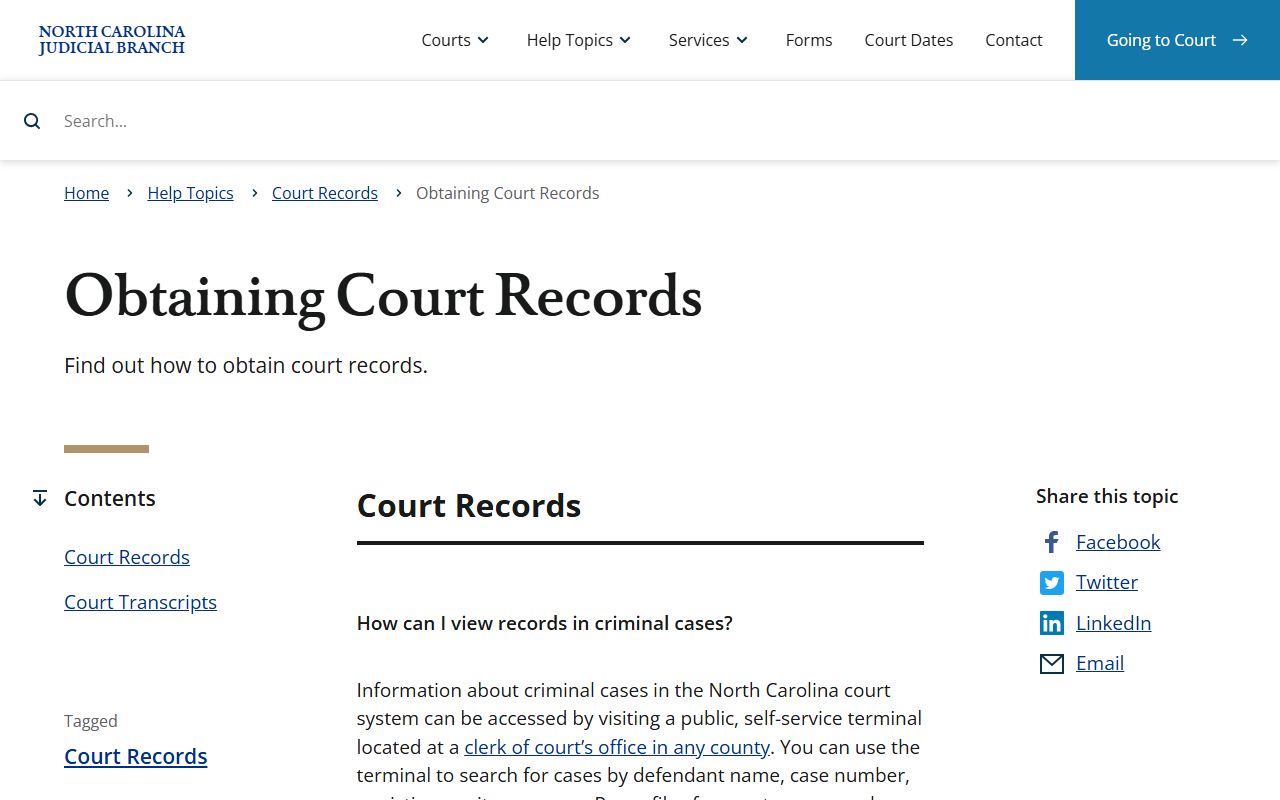
That source supports the local fallback chain: search online first, then use a public terminal or the Richmond County clerk for the file.
Richmond County Court Records Search Fields
Smart Search works best when the search term is narrow. The research file captured the Portal's visible field logic, including wildcard rules. A case-number wildcard needs at least four characters. A name wildcard needs at least three characters plus an asterisk for the last name and at least one character plus an asterisk for the first name. Business names can be searched in Advanced Filtering Options, and a comma in a business name should be replaced with an asterisk.
| Field Label | Type | Required | Notes / Format |
|---|---|---|---|
| Record Number or Name | Text | Yes for basic search | Accepts a case number or a name in Last, First Middle Suffix format. |
| Last Name | Text | Conditional | Use at least three characters plus an asterisk for wildcard searches. |
| First Name | Text | Conditional | Use at least one character plus an asterisk when using first-name wildcard search. |
| Filter by Location | Dropdown | No | Select Richmond County to avoid statewide results when the county is known. |
| Filter by Case Type | Dropdown | No | Narrows civil, criminal, family, probate, mental health, or other case groups when available. |
| File Date Start / End | Date | No | Useful when a common name returns too many Richmond County records. |
The Remote Public Access Program is a separate statewide data-access program for licensed users. It should not be confused with ordinary free public case lookup. Public users normally use the Portal or clerk terminals, while approved users may have a different access agreement and different data scope.
The Remote Public Access Program source is included among the Richmond County court records images.
The image reinforces that remote access is a defined Judicial Branch program, not a substitute for every public file at the county clerk's office.
Types of Richmond County Court Records
Richmond County is part of North Carolina's unified General Court of Justice. There are no county-created municipal courts handling separate Richmond County court records. The practical split is between Superior Court and District Court. Superior Court handles felony cases, larger civil cases, and appeals from District Court. District Court handles misdemeanors, infractions, domestic matters, juvenile matters, small claims through magistrate proceedings, many civil cases, and most traffic matters.
Court records differ from sheriff records and Register of Deeds records. Police reports and jail custody records are held by law-enforcement agencies. Marriage, birth, death, land, and many recorded-document files are handled by the Richmond County Register of Deeds. Court records are the files created by court cases, hearings, filings, orders, judgments, and clerk actions.
- Civil records include complaints, answers, motions, orders, judgments, liens, lis pendens, foreclosures, partitions, and condemnations.
- Criminal records include misdemeanor, felony, and infraction case files, with charges, hearings, pleas, dispositions, sentencing, fines, costs, and probation fields where public.
- Family records include divorce, custody, child support, domestic violence, and other District Court family matters, subject to restrictions for some case types.
- Probate and estate records are handled by the Clerk of Superior Court, who acts in the probate role under North Carolina practice.
- Traffic and infraction records show citation, charge, court date, waiver or appearance, disposition, costs, and DMV reporting where applicable.
- Judgment records can be searched through NC Judgment Search when the judgment index is the right tool.
What Richmond County Court Records Show
A public case summary is not always the same as the full paper file. The Portal training material says case summaries may include case information, assignment information, party information, causes of action for civil, family, probate, and mental health cases, events, dispositions, hearings, and financial information. A Richmond County paper file may contain pleadings, signed orders, notices, motions, and other documents that are not fully shown in the public online summary.
| Field | What It Shows |
|---|---|
| Case Number | The court file number, such as a North Carolina criminal format using CR or a civil format such as CVD. |
| Filing Date | The date the action, charge, petition, or proceeding was opened in the court system. |
| Parties | Names and roles, such as plaintiff, defendant, petitioner, respondent, or other party type. |
| Events | Docket or register-of-actions entries that track filings, hearings, notices, and orders. |
| Hearings | Scheduled or completed court appearances, with hearing type and location when public. |
| Disposition | The outcome of a charge, claim, petition, or judgment entry. |
| Financial Information | Costs, fines, fees, or other money entries when they are part of the public case summary. |
The Judicial Branch also provides a public records request route for existing Judicial Branch administrative records. That route is not the primary way to obtain a Richmond County case file, but it matters when the requested record is an administrative Judicial Branch record rather than a court case document.
The Judicial Branch public records request source is one of the images assigned to Richmond County court records.
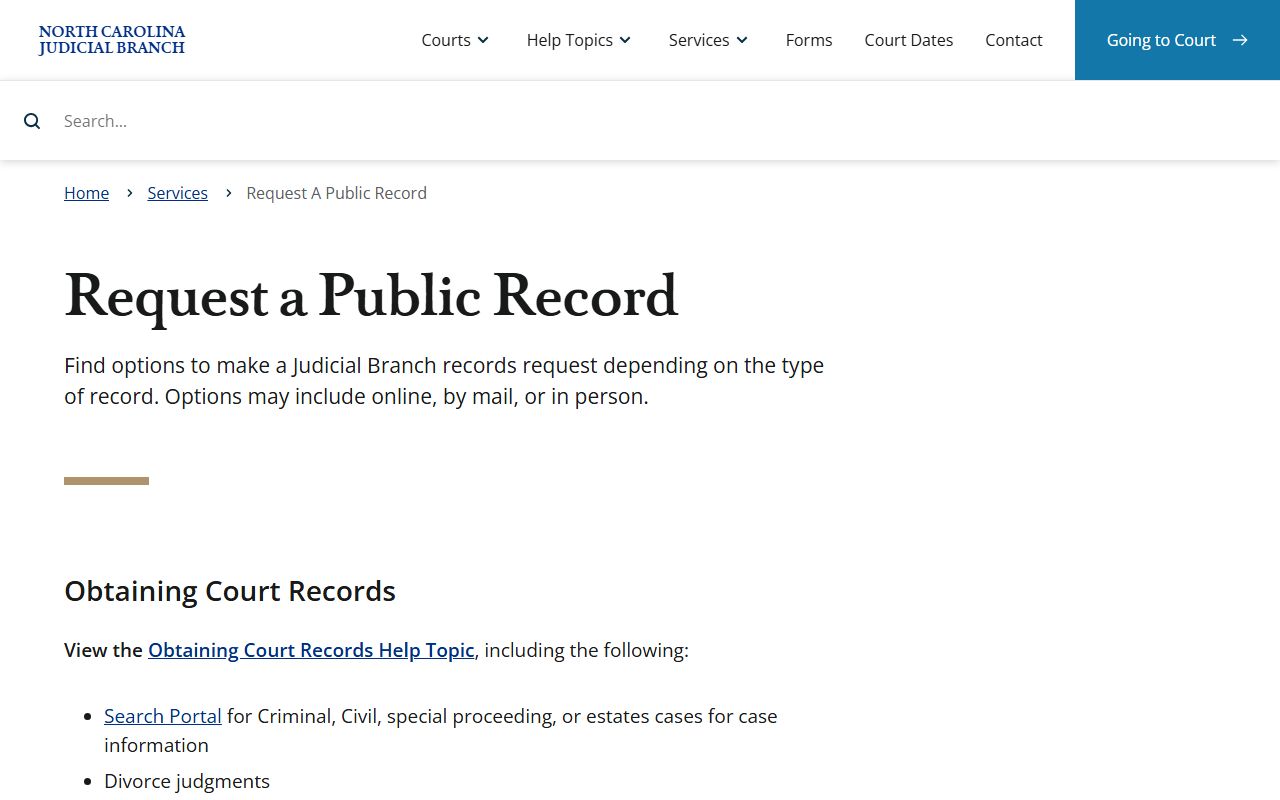
Use that request channel for administrative records, while case records still route through Portal, clerk terminals, paper files, or the Richmond County Clerk of Superior Court.
Public Access for Richmond County Court Records
North Carolina court-record access is grounded in G.S. 7A-109. That statute states that clerks maintain records, files, dockets, and indexes, and that those records are open for public inspection during regular office hours unless the law prohibits access. For Richmond County, that means public access is available, but it does not mean every record is online, free to download, unrestricted, or available in certified form through the Portal.
Chapter 132 of the North Carolina General Statutes is also relevant for state, county, sheriff, and administrative public records. Court files have their own court-record statute, while sheriff records and county administrative records may be requested from the agency that keeps them. Agencies may charge permitted copy costs and are not required to create a record that does not exist.
Note: Public inspection rights do not override juvenile, adoption, sealed, expunged, mental health, or identifier-redaction limits.
The G.S. 7A-109 court-record statute appears in the Richmond County court records image set.
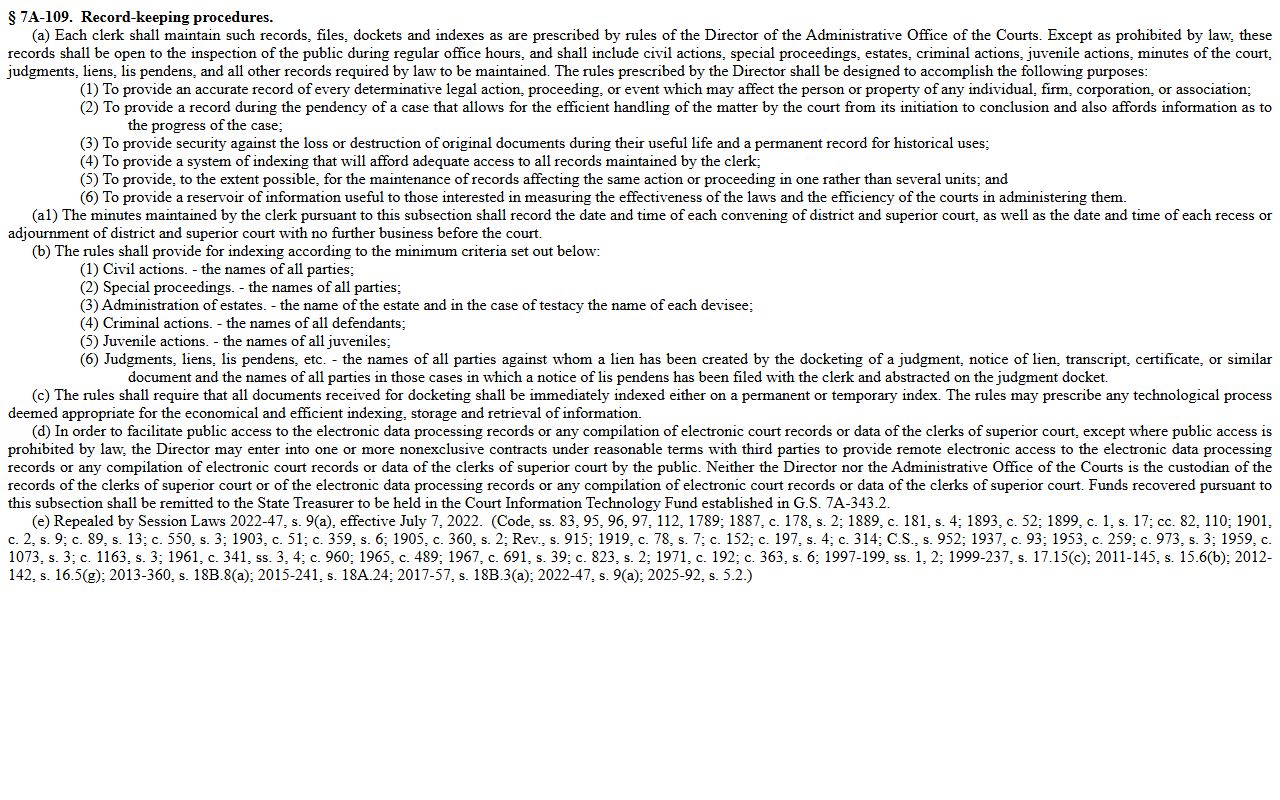
That statute is the key reason Richmond County court files are treated differently from ordinary county administrative records.
The broader North Carolina Chapter 132 public records source is also part of the Richmond County court records source set.
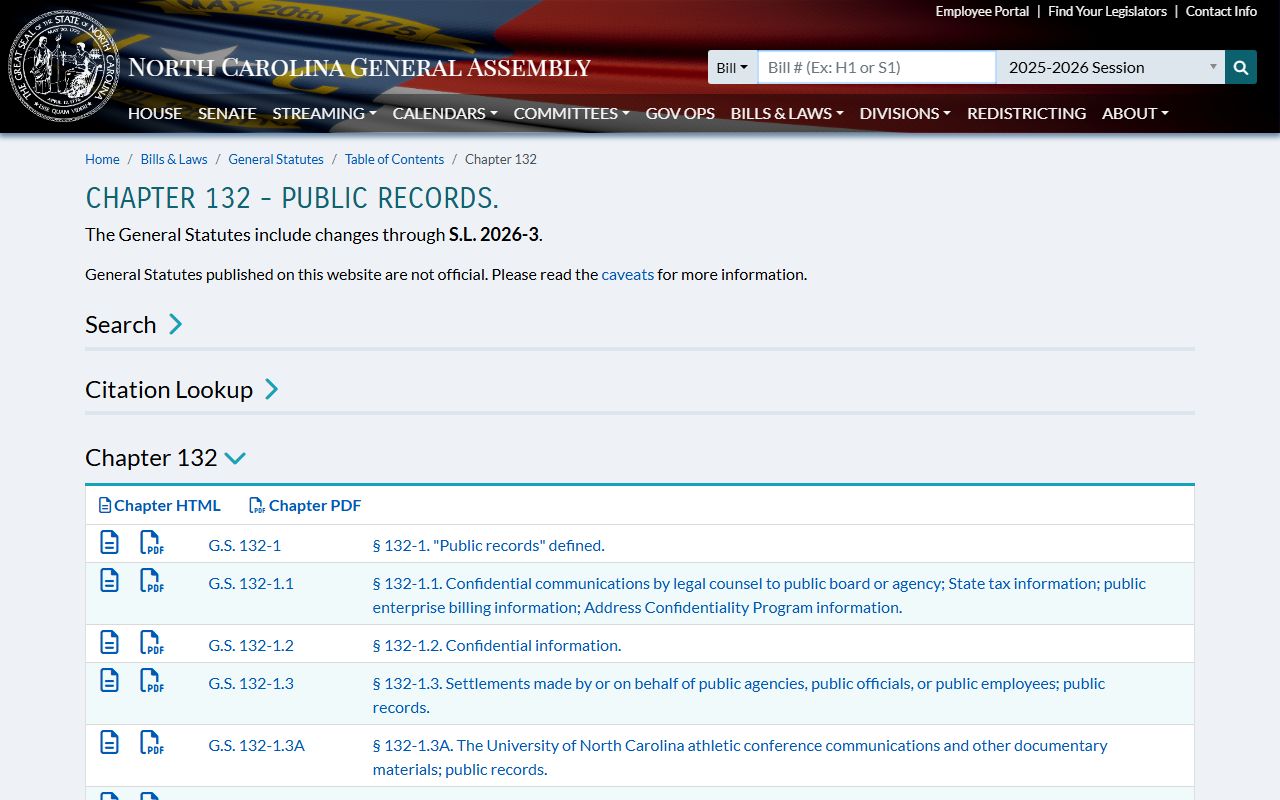
Chapter 132 is most helpful when the requested record belongs to a public agency outside the court case file itself.
Restricted Richmond County Court Records
Some Richmond County court records are restricted by law or court order. Juvenile delinquency, abuse, neglect, dependency, adoption, mental health commitment, sealed, and expunged records should not be assumed to appear in public Portal search results. Family case headings may appear differently from the underlying sensitive file, and public access can vary by case type, party role, and order.
Expunction is the court process that removes or seals qualifying criminal records. The Judicial Branch explains that adult and juvenile expunction rules differ, and eligibility depends on offense type, disposition, age, prior record, waiting period, and statutory conditions. A person usually starts with the Richmond County case number and disposition, identifies the correct AOC petition, files in the county of the case, and waits for review and a court order.
The Judicial Branch expunction help topic is included as a Richmond County court records image source.
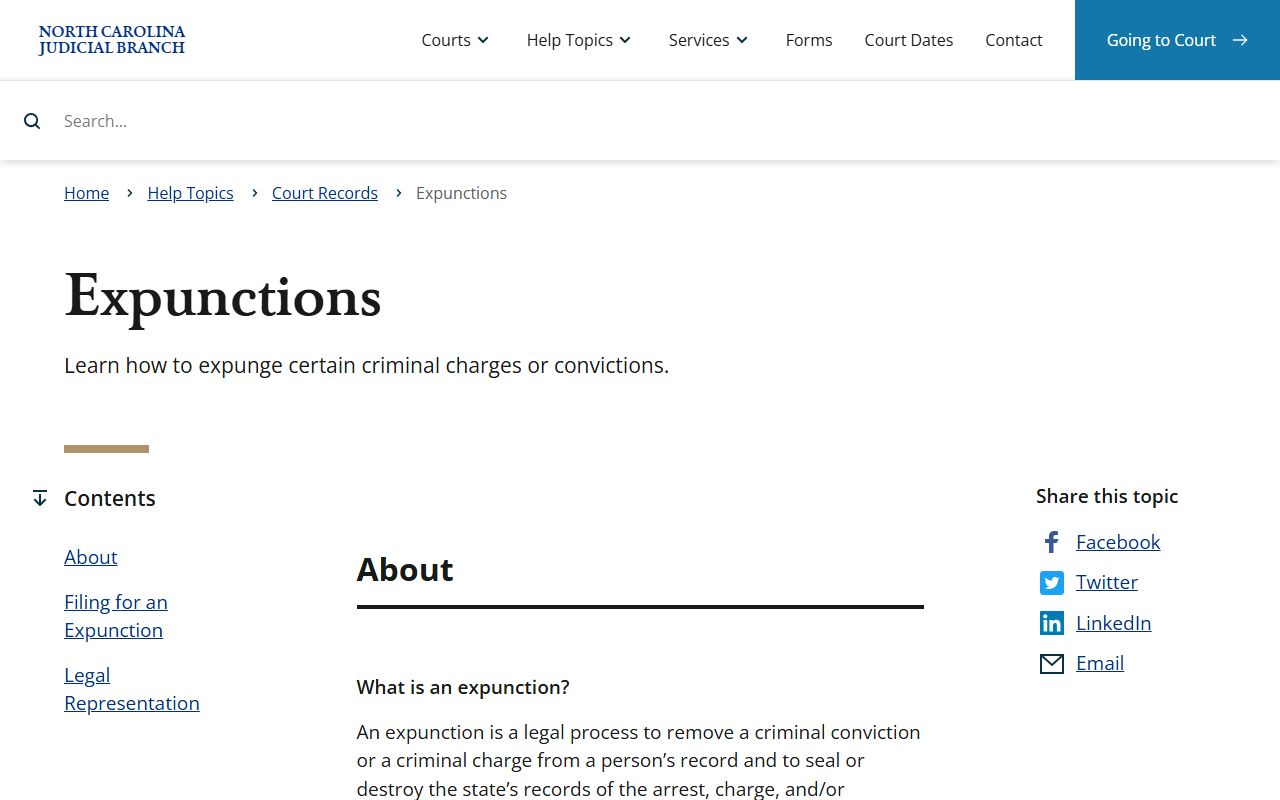
That source supports the caution that a dismissed or old charge is not automatically removed from public access without the proper expunction process.
Richmond County Court Record Requests
The Richmond County Clerk of Superior Court is the local office for court file inspection, certified copies, public terminal access, divorce judgments, criminal case records, civil files, special proceedings, estates, and certified single-county criminal background checks. For online payments, the Richmond County payment page says in-person payment can be made at the Cashier's Office and mail payments must use a money order or certified check payable to Richmond County Clerk of Superior Court. Certified criminal background checks use Form AOC-CR-314 and carry the researched $25 single-county fee.
Richmond County Clerk of Superior Court
Richmond County Judicial Center
105 W Franklin St
Rockingham, NC 28379
(910) 419-7400
Monday-Friday, 8:00 AM-5:00 PM
Bring the case number if possible. If no number is known, bring names, date range, case type, and any hearing or citation details. For criminal background checks, use the clerk's certified process rather than treating a Portal name search as an official criminal history.